

Scar
The Misunderstood Mastermind of Pride Rock

Good Morning Friends!
In the vast savannah of Disney villainy, few names are spoken with as much weight as Scar. The brooding, sharp-tongued antagonist of The Lion King has long been painted as the ultimate schemer—cunning, ruthless, and power-hungry. But what if we’ve misunderstood Scar all along? Could it be that beneath his villainous exterior lies a character shaped by neglect, rejection, and the pressures of royal hierarchy? Let’s step into Scar’s paws and explore the psychology behind one of Disney’s most iconic villains.
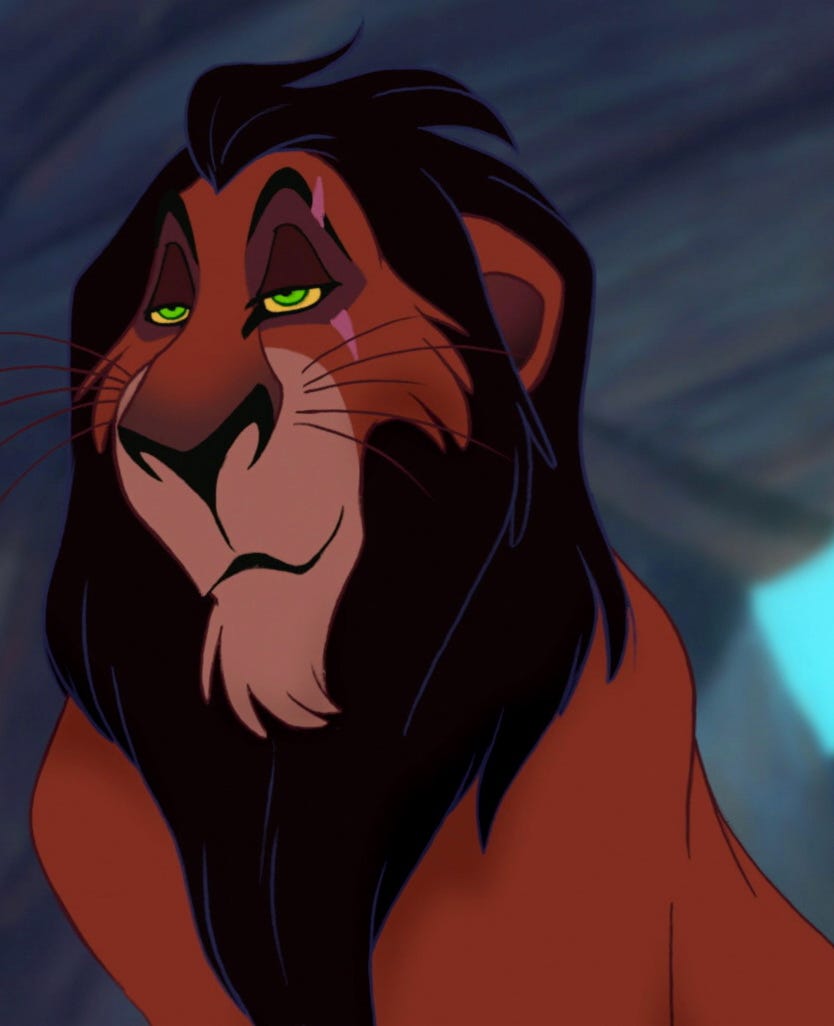
The Shadow of Mufasa
From the very start, Scar is established as “the other.” He is Mufasa’s younger brother, but unlike the strong, golden-maned king, Scar is physically weaker, slender, and adorned with a scar over his eye—a visual cue that sets him apart. In a society that values strength and dominance, Scar’s intelligence and cunning are overlooked, leaving him embittered and resentful.
Sibling rivalry is a powerful force in many families, and Scar’s resentment towards Mufasa may stem from years of playing second fiddle. Imagine growing up in a world where your older brother is the epitome of leadership and strength while you are constantly reminded of your shortcomings. Is it any wonder that Scar developed a sharp wit and a thirst for recognition? His ambition may have been born not out of pure malice, but out of a deep-seated desire to prove his worth.
The Black Sheep of the Pride
Scar’s exile from power isn’t just about birth order—it’s about the rigid societal expectations placed upon him. Lion prides operate with a clear hierarchy, and Scar’s lack of physical prowess automatically disqualifies him from leadership in the eyes of others. The Lion King presents a world where strength reigns supreme, and Scar simply doesn’t fit the mold. If he had been born in another time or place, perhaps his intelligence and strategic thinking would have been valued instead of dismissed.
Rejected by the lions, Scar finds allies in the hyenas—another marginalized group. While they are portrayed as dim-witted and savage, their alliance with Scar speaks volumes. He offers them a chance at survival, something the lion monarchy denied them. From Scar’s perspective, he isn’t just taking power for himself—he’s redistributing it to those who have been cast aside.
Villain or Visionary?
Scar’s rule over the Pride Lands is often viewed as disastrous but consider his intentions. He sought to change the natural order, to create a kingdom where the outcasts had a place at the table. Was he selfish? Absolutely. But was he entirely wrong? That’s up for debate. The problem wasn’t Scar’s desire for change—it was his inability to sustain it. His reign was marked by overindulgence and a lack of sustainable leadership, leading to the land’s decline. In the end, Scar’s downfall wasn’t just due to Simba’s return, but also his own shortsightedness.
A Lesson in Perspective
Scar’s story is a cautionary tale of what happens when intelligence is undervalued, and ambition turns to bitterness. Had he been given a role that acknowledged his strengths, perhaps his path would have been different. Instead, he was cast as the villain, and so he became one.
So, is Scar truly evil, or is he just a product of an unforgiving system? Like many Disney villains, his motivations are complex, and when we look beyond the surface, we see a character shaped by rejection and frustration rather than pure malice. Maybe, just maybe, we’ve been too quick to judge the lion with the scarred past.
Until Next Time, Stay Hooked My Friends,
Matt