

King Candy: The Misunderstood Mastermind of Sugar Rush

Good Morning Friends!
When it comes to Disney villains, few are as flamboyant and deceptively charming as King Candy from Wreck-It Ralph. With his whimsical, eccentric personality and a voice reminiscent of the Mad Hatter, he seems more like a quirky ruler than a true villain at first glance. But as the movie unfolds, we discover the dark truth—King Candy is actually Turbo, a once-beloved arcade racer who went to extreme lengths to stay relevant.
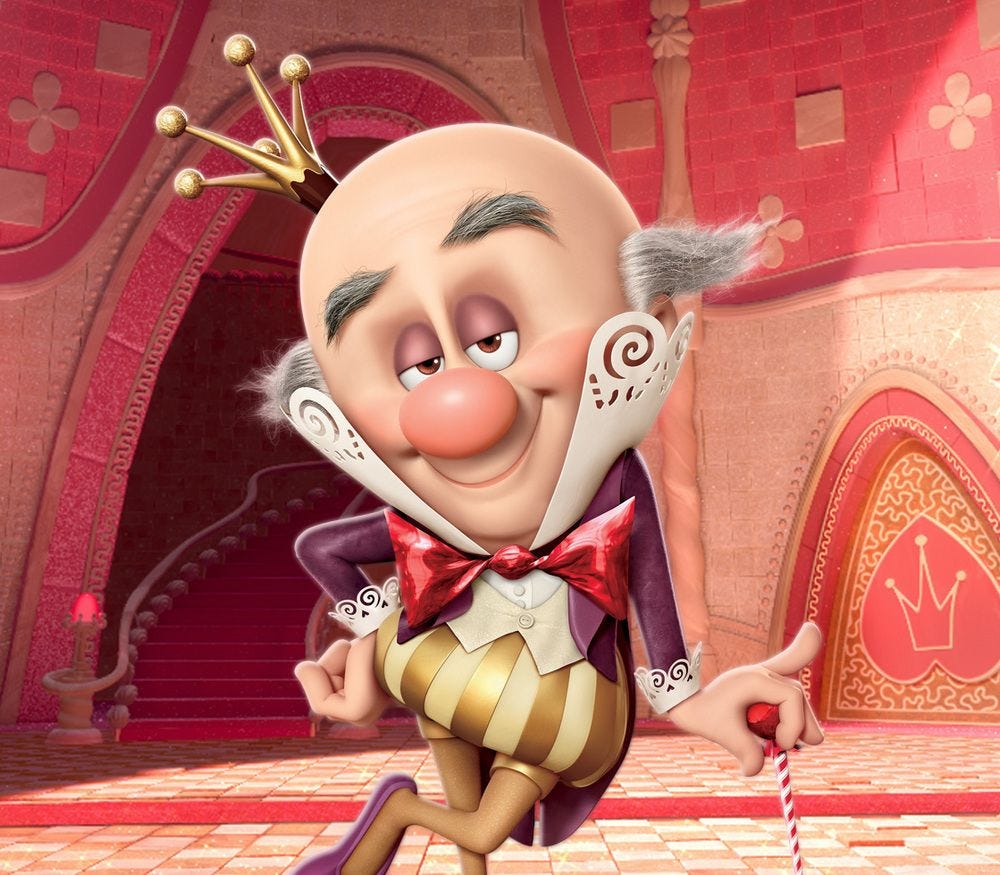
At first, it's easy to label King Candy as just another power-hungry villain clinging to his throne. But is he really the ultimate bad guy, or is there more to his story? Could King Candy actually be a misunderstood character, acting out of fear rather than pure evil? Let’s dive into his psychology and see if there’s more sugar than spice beneath his coded layers.
The Fear of Obsolescence: Turbo’s Driving Force
King Candy’s actions are driven by one powerful emotion—fear. In the world of arcade games, obsolescence is a death sentence. If a game loses popularity, it gets unplugged, taking its characters down with it.
Before becoming King Candy, Turbo was a star racer in his own game, TurboTime. He was the face of the arcade—until newer, flashier racing games stole his spotlight. Unable to accept fading into irrelevance, he abandoned his own game, tried to take over another, and ultimately caused both to be unplugged. That should have been the end of Turbo, but somehow, he found a way to infiltrate Sugar Rush, reprogramming its code and erasing the rightful ruler, Vanellope von Schweetz, from memory.
But why did he do this?
Because to Turbo (a.k.a. King Candy), survival wasn’t just about maintaining power—it was about existence itself. If he didn’t stay in control, if he didn’t remain at the top, he risked being forgotten forever. And that terrified him more than anything.
Was He Protecting Sugar Rush… or Himself?
One could argue that King Candy truly believed he was doing what was best for Sugar Rush. He tells Ralph that Vanellope racing could cause the game to crash, resulting in all the characters becoming homeless glitches.
Sure, this turned out to be a lie—but from King Candy’s perspective, it was a necessary one. He had already seen what happened when a game got unplugged. He had lived that nightmare. Maybe, deep down, he convinced himself that rewriting Sugar Rush's code wasn’t just about him—it was about preserving the world he had built.
Does that justify his actions? No. But it does make them understandable. He wasn’t just an evil tyrant for the sake of being evil. He was a character desperately clinging to existence, willing to do anything to avoid being erased.
The Lesson of King Candy: Change is Inevitable
King Candy’s story is ultimately a cautionary tale about resisting change. His refusal to accept a new reality—one where he wasn’t the star—led him to villainous acts that destroyed his original game, hurt innocent characters, and ultimately led to his own demise.
His greatest flaw wasn’t just his selfishness, but his inability to adapt. If he had embraced a new role rather than trying to control everything, perhaps he could have found a way to exist without resorting to deception and manipulation.
Final Verdict: Villain or Victim of His Own Fear?
At the end of the day, King Candy (or Turbo) is both a villain and a tragic figure. He made terrible choices, hurt others, and manipulated those around him—but all out of a deep-seated fear of being forgotten.
In a way, he represents something we all fear: becoming obsolete, being left behind, losing our purpose. But unlike Turbo, we have the ability to adapt, evolve, and grow.
So, the next time you play Sugar Rush (or any game, really), spare a thought for King Candy. Underneath the flashy coat and buggy programming was a character who just wanted to matter—but took the wrong path to make that happen.
And that, dear readers, is why Disney villains are never just villains—they’re reflections of real human fears, wrapped in animation and candy-colored deception.
Until Next Time…Stay Hooked My Friends,
Matt